

Cultural_Traditions
Mahsulot tavsifi
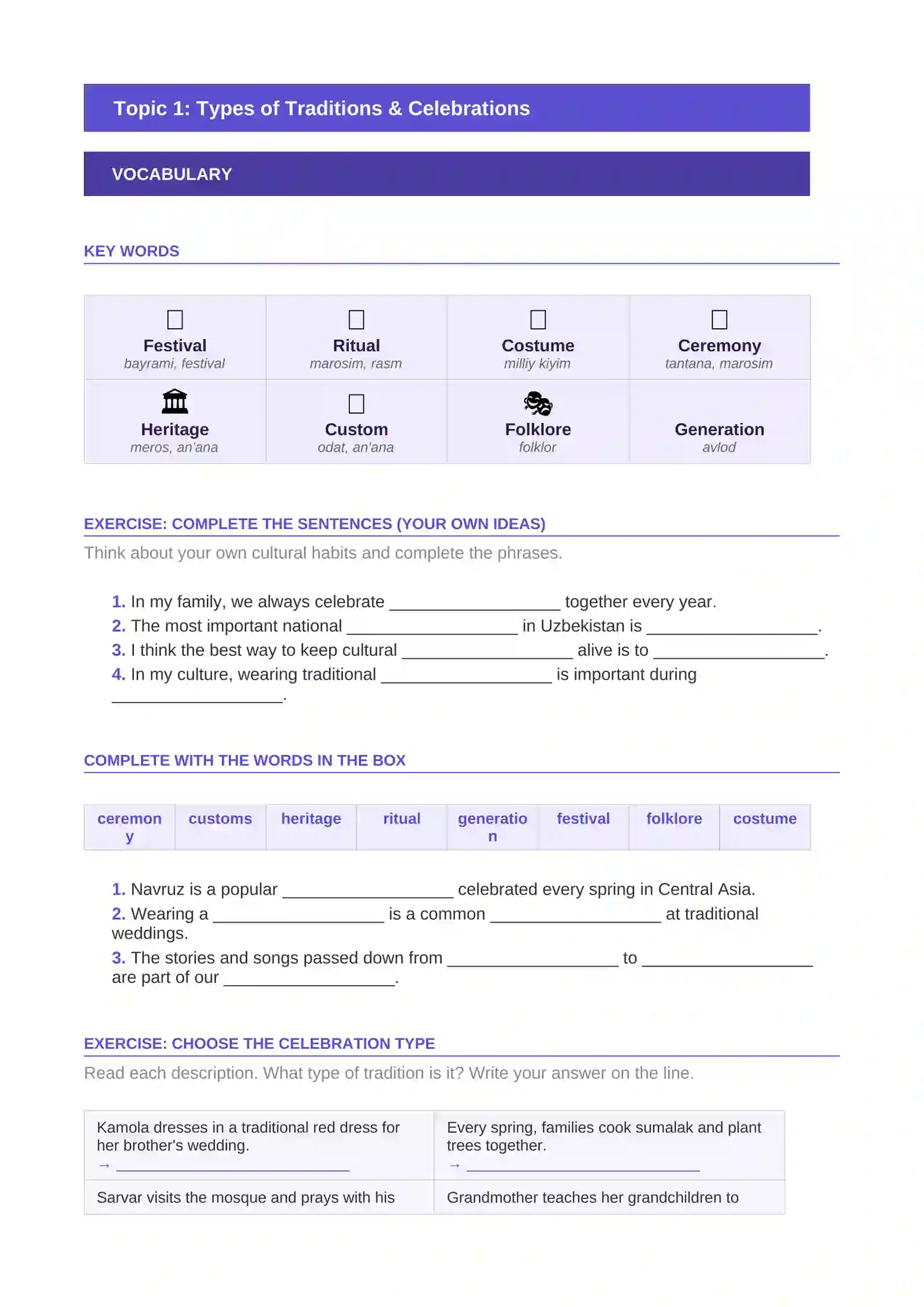
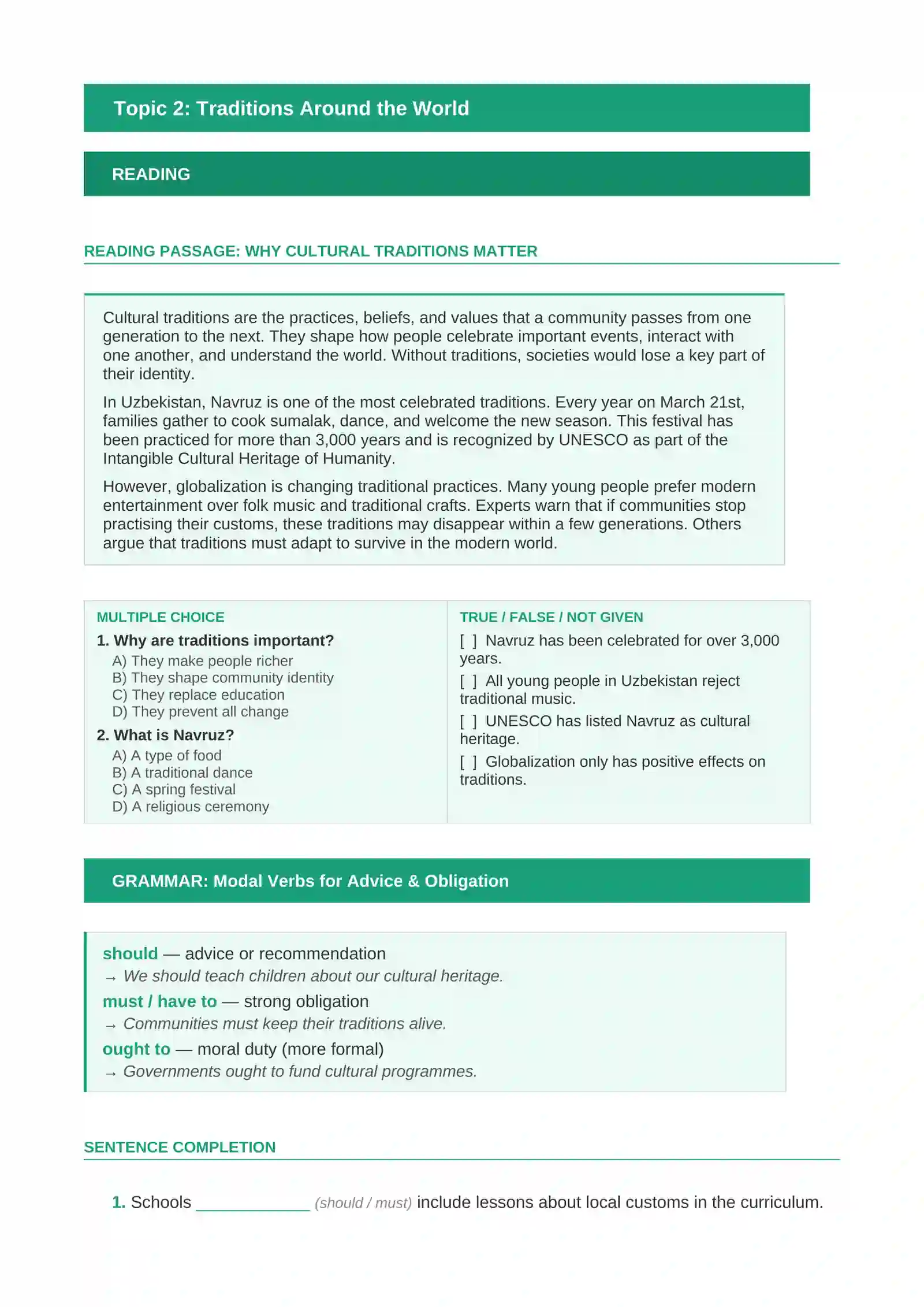
CULTURAL TRADITIONS Discover the rich world of customs, festivals & heritage —from ancient rituals to modern celebrations across the globe. 🎎Festivals & CeremoniesTraditional celebrations & cultural events🍲Food & CuisineHeritage recipes & culinary traditions🧶Arts & CraftsHandmade traditions passed through generations🌍Global CustomsComparing traditions around the world Learn new vocabulary & conversation skills VocabularyReadingListeningSpeakingGrammarWriting Topic 1: Types of Traditions & Celebrations VOCABULARY KEY WORDS 🎉Festivalbayrami, festival🕌Ritualmarosim, rasm👘Costumemilliy kiyim🥁Ceremonytantana, marosim🏛️Heritagemeros, an'ana🙏Customodat, an'ana🎭Folklorefolklor👨👩👧Generationavlod EXERCISE: COMPLETE THE SENTENCES (YOUR OWN IDEAS)Think about your own cultural habits and complete the phrases. 1. In my family, we always celebrate __________________ together every year.2. The most important national __________________ in Uzbekistan is __________________.3. I think the best way to keep cultural __________________ alive is to __________________.4. In my culture, wearing traditional __________________ is important during __________________. COMPLETE WITH THE WORDS IN THE BOX ceremonycustomsheritageritualgenerationfestivalfolklorecostume 1. Navruz is a popular __________________ celebrated every spring in Central Asia.2. Wearing a __________________ is a common __________________ at traditional weddings.3. The stories and songs passed down from __________________ to __________________ are part of our __________________. EXERCISE: CHOOSE THE CELEBRATION TYPERead each description. What type of tradition is it? Write your answer on the line. Kamola dresses in a traditional red dress for her brother's wedding.→ ___________________________Every spring, families cook sumalak and plant trees together.→ ___________________________Sarvar visits the mosque and prays with his family during Eid.→ ___________________________Grandmother teaches her grandchildren to bake traditional bread.→ ___________________________The school performs a play about ancient Uzbek legends.→ ___________________________People from 50 countries attend the International Silk Road Festival.→ ___________________________ Topic 2: Traditions Around the World READING READING PASSAGE: WHY CULTURAL TRADITIONS MATTER Cultural traditions are the practices, beliefs, and values that a community passes from one generation to the next. They shape how people celebrate important events, interact with one another, and understand the world. Without traditions, societies would lose a key part of their identity.In Uzbekistan, Navruz is one of the most celebrated traditions. Every year on March 21st, families gather to cook sumalak, dance, and welcome the new season. This festival has been practiced for more than 3,000 years and is recognized by UNESCO as part of the Intangible Cultural Heritage of Humanity.However, globalization is changing traditional practices. Many young people prefer modern entertainment over folk music and traditional crafts. Experts warn that if communities stop practising their customs, these traditions may disappear within a few generations. Others argue that traditions must adapt to survive in the modern world. MULTIPLE CHOICE1. Why are traditions important?A) They make people richerB) They shape community identityC) They replace educationD) They prevent all change2. What is Navruz?A) A type of foodB) A traditional danceC) A spring festivalD) A religious ceremonyTRUE / FALSE / NOT GIVEN[ ] Navruz has been celebrated for over 3,000 years.[ ] All young people in Uzbekistan reject traditional music.[ ] UNESCO has listed Navruz as cultural heritage.[ ] Globalization only has positive effects on traditions. GRAMMAR: Modal Verbs for Advice & Obligation should — advice or recommendation→ We should teach children about our cultural heritage.must / have to — strong obligation→ Communities must keep their traditions alive.ought to — moral duty (more formal)→ Governments ought to fund cultural programmes. SENTENCE COMPLETION 1. Schools ____________ (should / must) include lessons about local customs in the curriculum.2. Young people ____________ (ought to / have to) learn at least one traditional skill from their elders.3. If we want our heritage to survive, we ____________ (must / should) take action now.4. Tourists ____________ (should / ought to) respect local traditions when visiting a new country. Topic 3: Preserving vs. Modernizing Traditions SPEAKING + WRITING DISCUSSION QUESTIONS 1. "The Store's Vibe": Does your city or village have a tradition that makes it unique? What would happen if it disappeared?2. "Then vs. Now": How do you think your grandparents' celebrations differed from how you celebrate today? Give specific examples.3. "Digital Heritage": Do you think sharing traditions on social media (TikTok, Instagram) helps or harms cultural authenticity?4. "Global vs. Local": Is celebrating international events like Halloween harmful to local traditions? Why or why not? SPEED DEBATE: TRADITION VS. PROGRESSEach side has 2 minutes to convince their partner. Use the points below. Traditionalists (Side A)Traditions give communities a shared identity.Cultural heritage connects us to our ancestors.Losing traditions means losing part of humanity.Young people should value their roots.Modernists (Side B)Traditions must evolve to stay relevant.Some customs are outdated and should change.Technology can reinvent traditions globally.People should choose freely which customs to keep. ACTIVITY: THE CULTURAL AMBASSADOR (GROUP TASK) Step 1 — ChooseSelect a tradition from Uzbekistan or another culture you know well.Step 2 — ResearchFind out its history, meaning, and how it is celebrated today.Step 3 — PitchPresent it using persuasive language: "You absolutely must try..."Step 4 — DebateDiscuss: Should this tradition be adapted for modern times? WRITING TASKDescribe a tradition that is special to you"Think about a celebration, custom, or ritual from your family or culture. Describe it in detail and explain why it is important to you personally."What the tradition is and where it comes fromWhen and how it is celebrated (what people do, wear, eat, say)How you feel during this tradition and why it matters to youWhether you think this tradition will survive the next 50 years My writing (write 80–120 words):______________________________________________________________________________________________________________________________________________________________________________________________________________________________________________________________________________________________________________________________________________________________________________________________________________________________________________________________________________________________________________________________________________________________________________________________________________________________________________________________________________
Teglar
Cultural_Traditions

Muallif
Hasan 437536
Tasdiqlangan sotuvchi